

Recently, many people have asked how to properly measure their home for flooring. I talked to Bob, our in-house installer, for his expert advice on how to measure for flooring. I'm hoping that you find this useful in determining how many square feet you will need. Remember, if you ever have any further questions, you can always check our Flooring 101 section or contact Bob and his team.

Sample
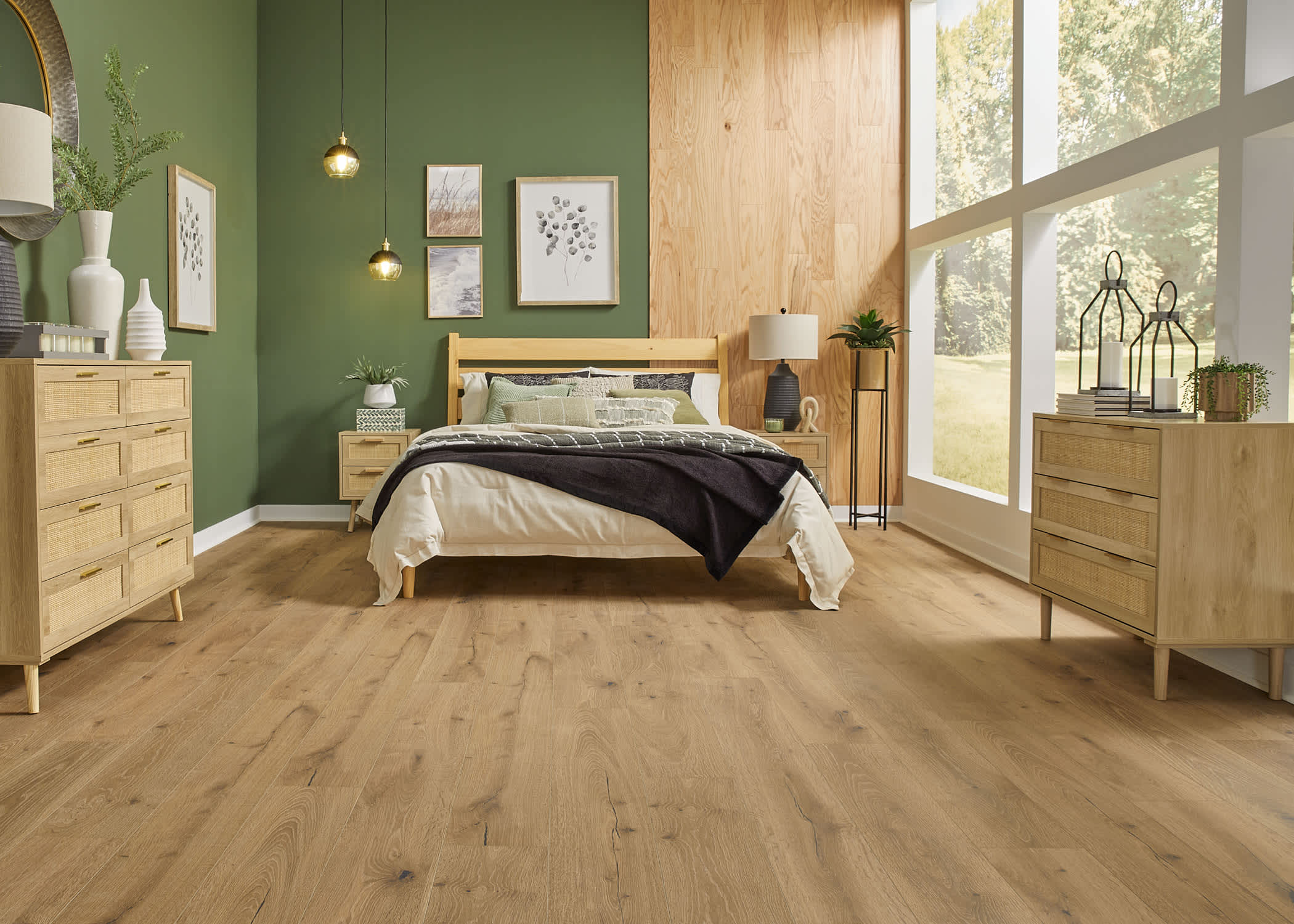
Bed room - measures 13’8”x 15’2”
When measuring for square footage,
the simplest method is to measure a room’s length x width (L x W). Use a tape measure
to measure from wall to wall or baseboard to baseboard, ignoring built-in
cabinetry. Using this bedroom as an example, if the room measures 13’8″ x 15’2″
round up the measurement to 14′ x 16′. The room area will now be 224 sqft.
Measuring for kitchens? Most dishwashers can be pulled out or have adjustable
front legs or panels to allow the flooring to be installed underneath about 3-4
inches. Don’t forget the closets!
= 3.14. The measurement from the
center to the edge is called its radius; the radius of this circle is 20’.
The area of a circle is the number
of square units inside this circle - the
area is our focus. Follow this equation for the area;
|
Area = π x R x R |
|
|
|
|
|
Area = 1,256 sqft |
The area of a triangle is the number of square units inside that triangle. It is
always half the sum of the height and base..
Triangle area = 1/2 b x h (base 10' x height 20')
(10' x 20') = 200 sqft
1/2 of 200 sqft = (100sqft)
Total Triangle sqft area is 100 sqft
Just as a new suit needs new shoes, don’t
forget the matching trim pieces for your new flooring. We offer transitions and
moldings to color-match most flooring. Trim moldings are not only decorative
but also functional, hiding perimeter expansion gaps and even speaker wiring! Transitions
also offer décor plus safety while moving or transitioning between varying
floor heights. When measuring for quarter round or base moldings, measure along
the floor at the wall-base the perimeter of a room, this will give you the “linear
feet” (Lnft). For example a 12x12 room would measure 12+12+12+12 or about 48’
Lnft of base moldings. When measuring for transitions there are only 4 basic
styles, each designed for special purposes; T-molding, reducer, end-caps, and
stair nosing. Keep in mind that these basic styles will work for about 95% of
most applications, about 5% will need to be modified slightly by the installer to
accommodate unique job site considerations.
Waste Factor and Placing the Order
Using the bedroom as an example, if
the room measures 13’8″ x 15’2″ round up the measurement to 14′ x 16′. The room
area will now be 224 sqft. Add a typical waste percentage for cutting, defects
or damages to complete the project. When placing the order, round up to the
next full box/container. Waste percentages are related to the selected product, for example; Laminates usually require about 8% extra be added to the square footage
totals. Corks, bamboo and most exotic hardwood need about 10-15% extra. Add about
5% extra for domestic hardwoods.
It is beneficial to know that some
wood species may require additional percentage be added to an order to account
for such factors as shading, hardness or brittleness like Australian Cypress.
These traits are considered species characteristics not defects. When ordering,
don’t forget to keep an extra box of material on hand for future repairs if
needed.
Last but certainly not least, it’s
worth noting that “special buys”, “close-outs” and “odd-lots” are usually
one-of-a-kind deals with no way to order extra product! Make sure to get what’s
needed at the time of purchase.
Comments